Copyfy: Improving sign up rate (+31%) & unifying data

About Copyfy
Copyfy is an AI-powered platform that helps users find a winning product and generate Shopify landing pages, product descriptions and digital assets in minutes. The product is designed for creators, founders, and small businesses that want to build an online presence without technical skills. With multiple templates, AI-assisted editing, and rapid publishing workflows, Copyfy makes it simple to go from idea to a ready-to-launch website in a few clicks.
Challenge 1: No Reliable Analytics & Limited Insight Into User Behaviour
Copyfy wanted someone to:
- Set up Mixpanel end-to-end
- Monitor data quality
- Build dashboards
- Uncover insights about user behaviour
- Support new feature releases with measurement
- Unify data coming from different product and marketing sources
Without this foundation, the team struggled to understand:
- Who their users were
- Where they came from
- Why users stayed or churned
- Which features worked, and which created friction
They needed a complete analytics workflow - not just event tracking.
Solution
We partnered closely with Copyfy to build a robust, scalable analytics system and convert raw data into actionable insights.
1. Designed a clean, comprehensive Mixpanel tracking setup
We mapped the product end-to-end and implemented:
- A structured event taxonomy
- Consistent properties across all events
- Tracking for activation, engagement, and retention journeys
- Feature-level tracking for new releases
Every key interaction now had accurate data behind it.
2. Worked with the dev team to implement & validate all events
- Guided engineering on accurate tracking
- Verified events live in Mixpanel
- Ensured data quality and consistency
3. Unified data from multiple sources into a single view
Copyfy had critical data across different systems.
We:
- Pulled these datasets together
- Cleaned and mapped the data
- Tied everything to a single user identity
This enabled behaviour-based segmentation, reactivation strategies, and full-funnel visibility.
4. Built dashboards for easy decision-making
We created Mixpanel dashboards to help the team understand:
- Product performance
- Feature adoption
- Drop-off patterns
- User journeys
- Retention trends
These dashboards became their day-to-day analytical command center.
5. Provided ongoing insights & product recommendations
By analyzing behaviour data, we helped the team:
- Identify product gaps
- Spot friction points
- Understand who stays, who churns, and why
- Evaluate the impact of new feature releases
Result
With a clean analytics foundation and unified user data:
- The team now moves much faster and makes decisions confidently
- They understand who their users are, where they come from, and which users stay long-term
- Product gaps are easier to identify and fix
- Reactivation strategies are more personalized and effective
- Leadership no longer relies on guesswork, they have clarity in their numbers
Copyfy now operates with a strong, insight-driven analytics workflow that supports both product growth and business strategy.
Challenge 2: Low Website-to-Signup Conversion
Copyfy noticed a significant drop-off in their onboarding funnel. A large portion of visitors were abandoning the product before completing sign-up, resulting in a website-to-sign-up conversion rate far below category benchmarks.
After reviewing the flow, it became clear that:
- The initial screens were visually cluttered and created cognitive load.
- The sign-up path did not match user expectations for speed and simplicity.
- Extra steps were added in the middle of the flow that did not provide clear value, causing friction and confusion.
This prevented high-intent visitors from completing the onboarding process.
Solution
We conducted a detailed funnel audit using Mixpanel and heuristics-based UX evaluation. The key actions included:
- Simplifying the UI: Removing distracting elements, tightening copy, and creating a cleaner, more intuitive layout.
- Eliminating unnecessary steps: We recommended removing redundant screens and consolidating actions to reduce friction.
- Aligning the experience with user expectations: Restructured the flow to feel fast, predictable, and aligned with how users expect an AI website builder to work.
- Running iterative experiments: Testing small changes in layout, messaging, and CTAs to identify what drives conversion uplift.
Result
The redesigned onboarding process had an immediate impact.
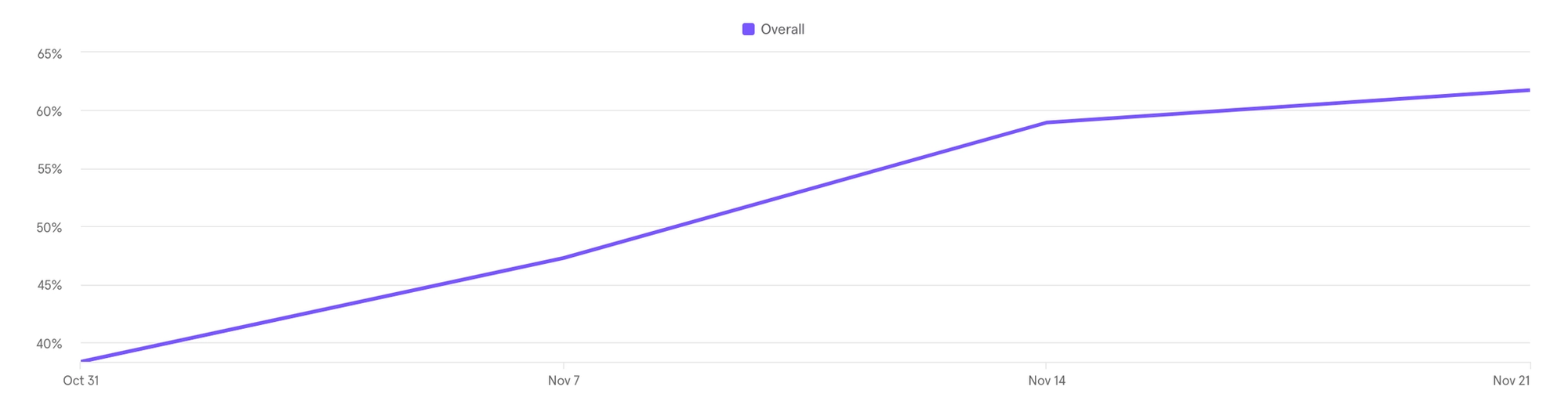
Sign-up conversion rate increased from 30% to 61%, more than doubling the number of users entering the product.